Smart toilets
Wall-hung or floor-standing toilet: what changes in the bathroom
Building work, space, water, power and cleaning: what changes in the bathroom if you choose a wall-hung or a floor-standing smart toilet, with the data from the Keliss specifications.
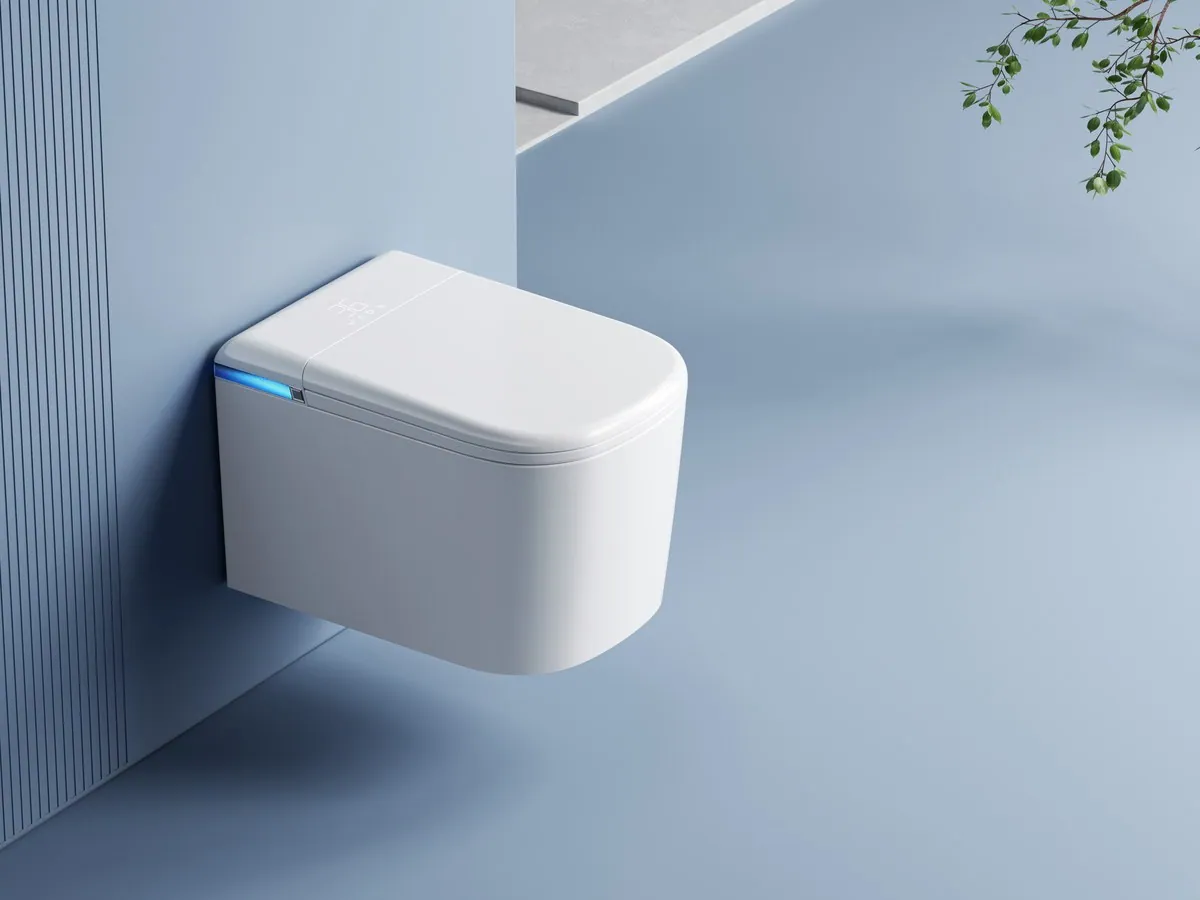
Choosing between a wall-hung and a floor-standing smart toilet is not just a question of taste. The work involved changes, as do the space the fixture takes up, the way the water arrives and even everyday cleaning. In another article we compared the forms in the range; here we take a closer look at what happens in the bathroom, with the data given in the Keliss specifications.
The work: the floor or the wall
A floor-standing toilet rests on the floor and connects to the waste outlet like a traditional toilet. This is why it is often the most direct choice when replacing an existing fixture. The Sanova S002F, for example, according to its specifications fits a standard rear floor outlet, with no concealed frame or cistern to plan. On models such as the EvoLux 3201 White and the NeoWash 0020 the specifications state the outlet distance as customisable by country: this is a detail to look at with your plumber before ordering.
A wall-hung toilet, on the other hand, is fixed to the wall and needs a structure to support it. Some wall-hung models are paired with a concealed cistern, such as the Sanova Y3WB and the Sanova I7: this is the natural solution when the wall is already open for a renovation. Others have the tank inside the body of the fixture, such as the Sanova Y3 and the Sanova S005F, and do not require a separate cistern.
Space: how much room the fixture takes up
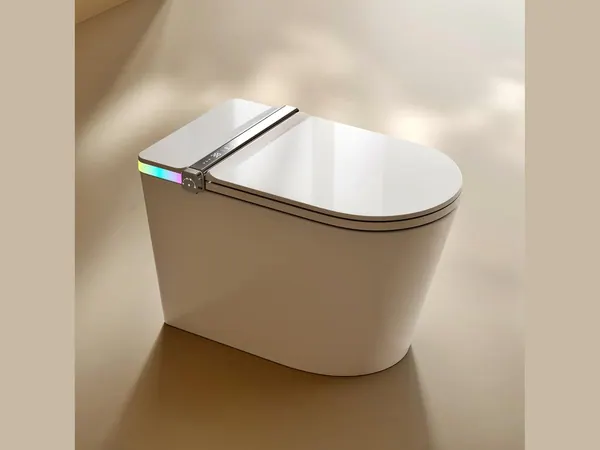
The dimensions are given in the specifications of each model, in the order width, depth and height. A wall-hung model such as the AeroLux 707 measures 590 × 390 × 364 mm; a floor-standing model such as the EvoLux 3201 White reaches 680 × 390 × 490 mm. Among floor-standing models too the differences are considerable: the AeroLux 706 is given as 590 × 375 × 436 mm.
In small bathrooms it is worth measuring the free space in front of the bowl and the distance from the door and the other fixtures. With a wall-hung toilet and concealed cistern, part of the bulk sits inside the wall: the depth of the service wall needs to be planned together with the fixture.
Water: pressure and tank
Many Keliss floor-standing smart toilets are tankless and take water directly from the mains: for the EvoLux 3201 White the specifications state a supply pressure from 0.07 to 0.75 MPa. On some models the tank is an option and changes the required pressure: for the NeoWash 0020 the specifications give 0.06 to 0.75 MPa with the tank and 0.15 to 0.75 MPa without.
Wall-hung models have their own values too: for the AeroLux 707 the specifications state from 0.1 MPa dynamic pressure to 0.55 MPa static. If the pressure in your home is low, this is a figure to measure before choosing, not after. Water consumption per flush is given as 4-4.5 litres for the AeroLux 707 and 4.8 litres for the EvoLux 3201 White.
Power: a socket near the fixture
Wall-hung or floor-standing, a smart toilet needs electricity to heat the water and the seat, for drying and for the automatic functions. The power varies from model to model: 1380 W for the Sanova Y3 and Sanova S002F, 1550 W for the AeroLux 707, 1600 W for the EvoLux 3201 White. With your electrician it is worth planning a power point near the fixture, suited to the power of the chosen model.
Everyday cleaning
A wall-hung toilet leaves the floor beneath the bowl clear, so you can mop without obstacles: this is one of the reasons it is popular in contemporary bathrooms. A floor-standing toilet, by contrast, has a base to clean all the way round. In both cases the same hygiene functions help, present depending on the model: the self-cleaning nozzle, UV sterilisation and the anti-splash foam layer before use.
In summary
- You are replacing a floor-standing toilet without touching the wall: a floor-standing model is the most direct route.
- You are renovating and the wall is open: a wall-hung toilet with a concealed cistern.
- Small bathroom and no cistern: a wall-hung toilet with an integrated tank, such as the Sanova Y3 or the Sanova S005F.
- Low water pressure: look at models with a tank, including optional ones, and compare the values in the specifications.
- In every case: a power socket near the fixture, suited to the power of the model.
Installation is carried out by your own plumber: before deciding, show them the specifications and manual of the model you are interested in. If you would like advice on your choice, write to us from the contact page.